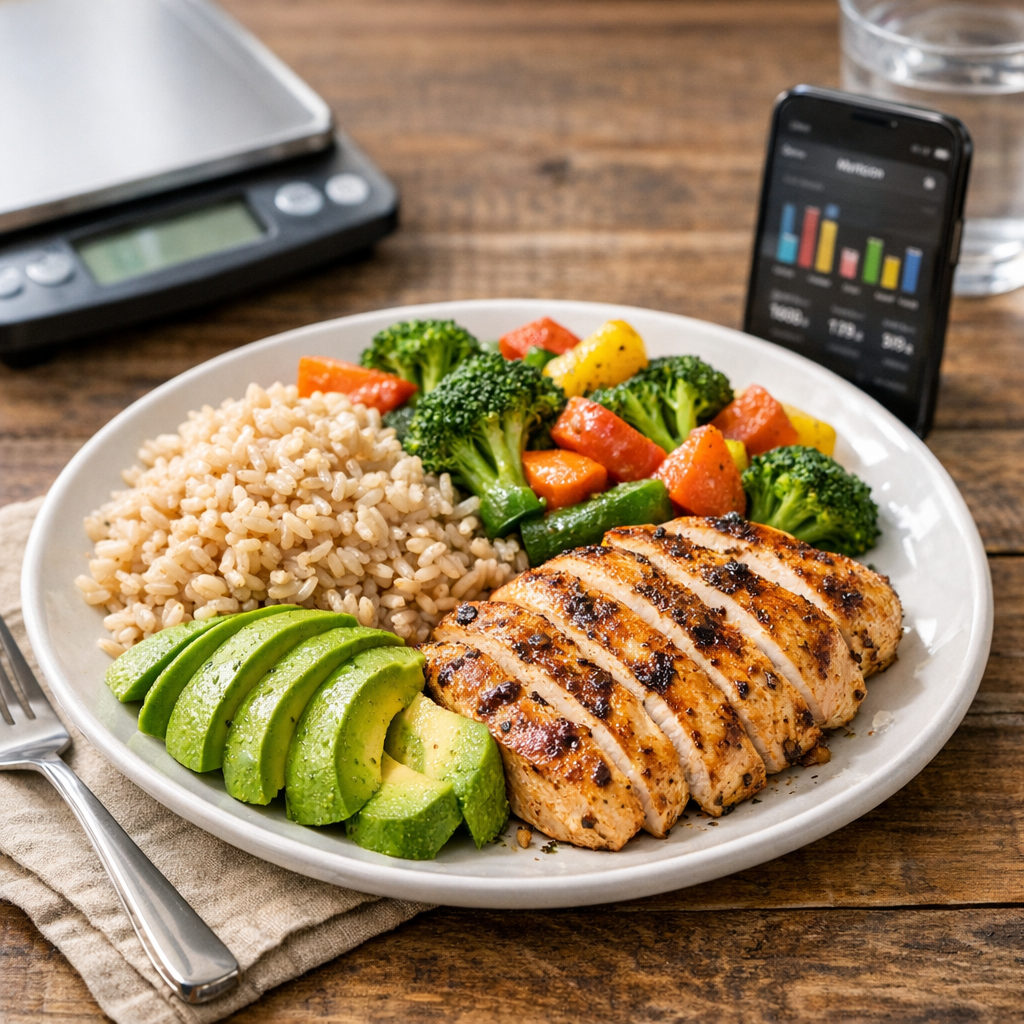
Short answer: Keep protein relatively steady, choose a sustainable calorie target for your goal, set enough dietary fat for a balanced diet, and use carbohydrates for the remaining calories. Fat loss generally requires consuming fewer calories than you use, while muscle gain usually requires enough energy plus progressive resistance training. The best macro targets are the ones you can follow, train well on, and adjust from real results. Macro targets do not replace food quality, so include fruits, vegetables, legumes, and whole grains that help you meet an appropriate daily fiber target.
How should macros change for fat loss vs. muscle gain?
The biggest difference is usually total calories—not a completely different protein, carbohydrate, and fat ratio. Protein can remain similar in both phases. When calories fall during fat loss, carbohydrates and fats normally make up most of the reduction. During a muscle-gain phase, additional carbohydrates are often useful because they help fuel hard training.
Goal | Calories | Protein | Carbohydrates | Fat
Fat loss | A sustainable deficit | Keep relatively high and consistent | Use the remainder after protein and fat | Keep within a balanced range
Muscle gain | Enough energy to support gradual gain | Keep relatively high and consistent | Often increased to support training | Keep within a balanced range
Maintenance or recomposition | Near maintenance, adjusted from trends | Keep relatively high and consistent | Match training demands | Keep within a balanced range
These are starting principles, not medical prescriptions. Your age, body size, training volume, food preferences, health conditions, and response over time all matter.
Step 1: Set a realistic calorie target
Calories determine whether your body has less, roughly the same, or more energy available over time. Start with an estimate, then treat it as a hypothesis. The
NIDDK Body Weight Planner can help adults build a personalized calorie and activity plan. It is not intended for people who are pregnant or breastfeeding, and it does not replace medical advice.
Avoid chasing the largest possible deficit or surplus. A more sustainable target makes it easier to train consistently, recover, and learn whether the plan is actually working. Monitor several weeks of body-weight trends, gym performance, hunger, energy, and measurements before making a major change.
Step 2: Set protein first
For healthy, physically active adults, the International Society of Sports Nutrition reports that roughly 1.4–2.0 grams of protein per kilogram of body weight per day is sufficient for most people who exercise. Individual needs can vary, especially during an energy deficit or with medical conditions.
To convert pounds to kilograms, divide body weight in pounds by 2.2. For example, a 165-pound person weighs about 75 kilograms. At 1.4–2.0 g/kg, the example range is about 105–150 grams of protein per day.
Protein provides four calories per gram. Once you choose a reasonable target, keep it fairly stable across fat-loss and muscle-gain phases. Spread protein across meals in a way that fits your schedule and choose foods you enjoy, such as poultry, fish, eggs, dairy, soy foods, beans, lentils, or other protein-rich options.
Step 3: Choose a balanced fat target
Dietary fat provides nine calories per gram. The National Academies’ acceptable macronutrient distribution range for adults places fat at 20–35% of total energy. That is a broad range, which means there is room for food preference and cultural eating patterns.
For a 2,000-calorie example, 25% of calories from fat equals 500 calories, or about 56 grams. For a 2,400-calorie example, the same percentage equals 600 calories, or about 67 grams. You do not need to hit the same percentage every day; use it as a planning range rather than a pass-or-fail rule.
Step 4: Let carbohydrates fill the remaining calories
Carbohydrates provide four calories per gram and can support training performance. After setting calories, protein, and fat, assign the remaining calories to carbohydrates:
Carbohydrate grams = (daily calories − protein calories − fat calories) ÷ 4
This “remainder” method is often easier than forcing every person into one fixed macro ratio. Someone who performs and feels better with more carbohydrates may choose a lower point within the fat range. Someone who prefers more fat may use fewer carbohydrates while keeping calories and protein appropriate.
Worked example: fat-loss macros vs. muscle-gain macros
Consider an educational example for a 75 kg (165 lb) active adult using 150 g of protein and 65 g of fat. These numbers are examples—not a recommendation for every 75 kg person.
Calculation | 2,000-calorie example | 2,400-calorie example
Protein | 150 g × 4 = 600 calories | 150 g × 4 = 600 calories
Fat | 65 g × 9 = 585 calories | 65 g × 9 = 585 calories
Calories left for carbs | 2,000 − 1,185 = 815 | 2,400 − 1,185 = 1,215
Carbohydrates | 815 ÷ 4 ≈ 204 g | 1,215 ÷ 4 ≈ 304 g
Notice what changed: protein and fat stayed the same while carbohydrates absorbed the calorie difference. That is not the only valid method, but it is simple and preserves fuel for resistance training.
How to know whether your macros are working
Macro calculations give you a starting point. Your trend data tells you whether that starting point fits your real life. Review:
• Body-weight trend: Compare weekly averages, not isolated daily weigh-ins.
• Strength and repetitions: Stable or improving performance is useful context, especially during fat loss.
• Body measurements and photos: These can show changes that body weight alone misses.
• Hunger, energy, sleep, and recovery: A plan that repeatedly harms these signals may be too aggressive or poorly matched to you.
• Adherence: If you cannot follow the targets consistently, simplify them before changing the math.
Hold the plan steady long enough to see a trend, then make a modest adjustment. Changing calories every few days makes the data difficult to interpret. Alongside your nutrition plan, use PumpPal to record training, body measurements, progress photos, and strength records. Our
guide to tracking progressive overload explains how to connect gym performance with physique goals.
Can you lose fat and gain muscle at the same time?
Body recomposition can happen, particularly for newer lifters, people returning after time away, or people with more body fat to lose. It still depends on consistent resistance training, adequate protein, recovery, and an energy intake appropriate for the individual. Progress may be slower and harder to detect than a dedicated fat-loss or muscle-gain phase.
Common macro mistakes
• Using a percentage without checking grams: A protein percentage can look high while still providing too little protein at low calories.
• Cutting carbohydrates automatically: Fat loss requires an energy deficit, not a mandatory low-carbohydrate diet.
• Pushing fat too low: Leave room for a balanced diet and foods you enjoy.
• Ignoring fiber and food quality: Macro totals do not replace fruits, vegetables, whole grains, legumes, and varied nutrient-dense foods.
• Changing targets too quickly: Water, sodium, digestion, and menstrual-cycle changes can temporarily move scale weight.
• Treating app estimates as exact: Food labels, restaurant meals, wearables, and calorie calculators all contain error.
Frequently asked questions
Should protein change between fat loss and muscle gain?
It often does not need to change much. Many active adults can begin within the 1.4–2.0 g/kg/day range, then personalize it based on training, total calories, food preference, and professional guidance.
Should I lower carbs or fat to lose weight?
Either can be adjusted. Total calorie intake and consistency matter more than declaring one macro universally “bad.” Preserve adequate protein, keep fat within a balanced range, and choose the carbohydrate-fat mix you can sustain while training well.
Do I need different macros on training and rest days?
No. Consistent daily targets are simpler and work well for many people. Some prefer more carbohydrates on demanding training days and fewer on rest days, but the weekly calorie pattern still matters.
How often should I adjust my macros?
Use several weeks of consistent data unless a clinician advises otherwise. If the trend does not match your goal and adherence is genuinely good, make one modest change and reassess.
Does PumpPal track food or macros?
PumpPal is designed to track workouts and physical progress rather than replace a dedicated nutrition tracker. Use it to log training, strength records, body measurements, and progress photos so you can evaluate whether your nutrition plan is supporting performance and body-composition goals.
The bottom line
To balance macros for fat loss versus muscle gain, start with the calorie level appropriate for the goal, keep protein relatively steady, choose a reasonable fat intake, and use carbohydrates for the remaining calories. Then compare the plan with real trends instead of treating the first calculation as permanent.
Nutrition and training work together. Download PumpPal (/) to organize workouts and monitor the progress signals that help you decide whether your current plan is working.
Sources and important safety note
This article is for general education and is not medical advice. People under 18, anyone who is pregnant or breastfeeding, anyone with an eating-disorder history, and people with diabetes, kidney disease, or other conditions affecting nutrition should consult a qualified clinician or registered dietitian before changing calorie or macro targets.