

L-Sit (on floor or between chairs) exercise
The L-sit is a powerful isometric bodyweight exercise that builds exceptional core, hip flexor, tricep, and shoulder strength. Performed on the floor or between elevated surfaces like chairs or parallettes, this advanced movement requires full-body tension, stability, and control. It’s commonly used in gymnastics and calisthenics to develop strength, endurance, and muscle definition.
Updated By PumpPal
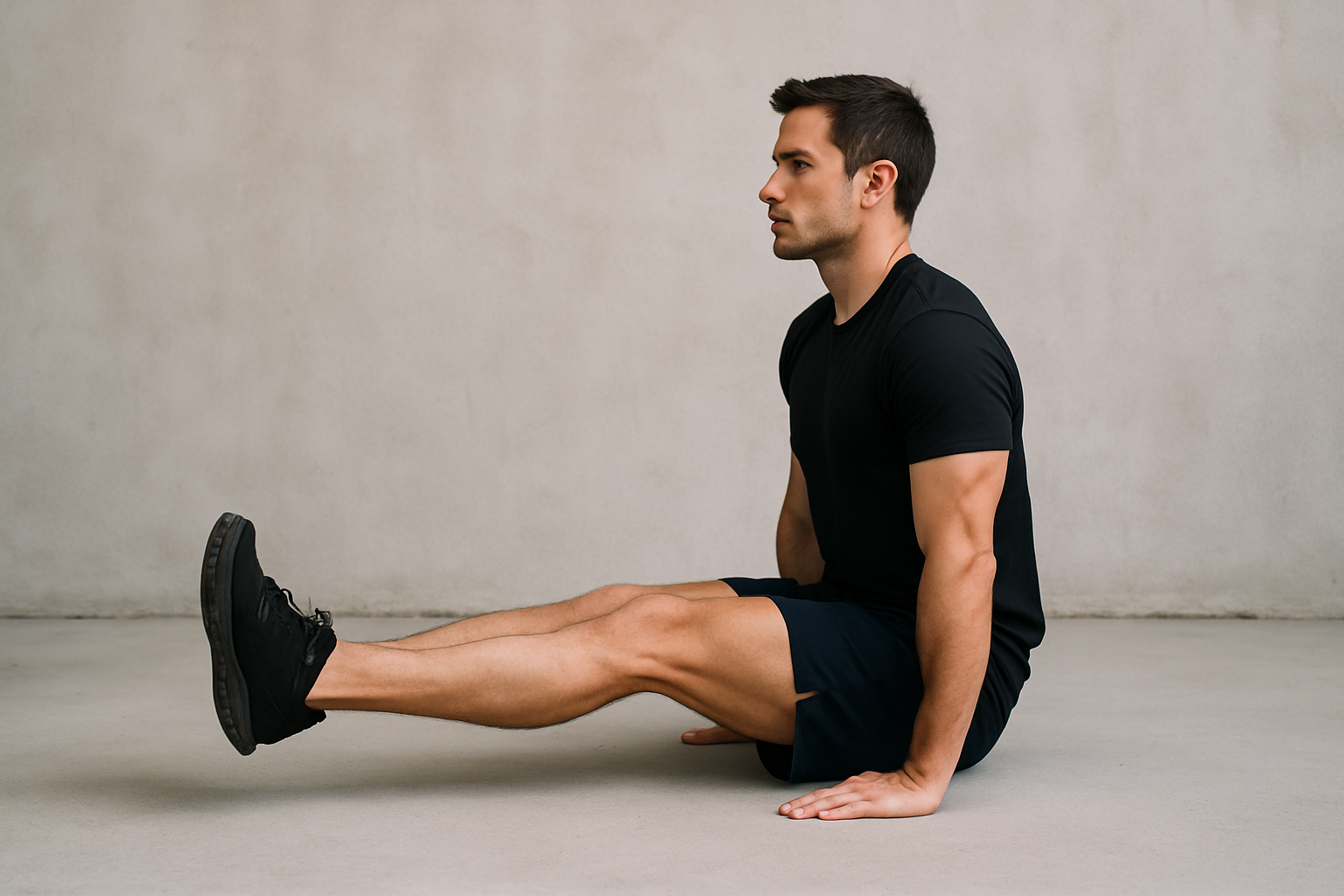
How to perform L-Sit (on floor or between chairs)
- Sit on the floor with your legs extended straight in front of you and your hands flat on the floor beside your hips.
- Press your hands into the ground and engage your core and legs.
- Lift your entire body off the floor, keeping your legs straight and together in front of you.
- Maintain a 90-degree angle between your torso and legs, forming an 'L' shape.
- Hold this position for as long as possible, keeping your core tight and arms locked.
- Lower yourself back to the floor with control once your form begins to break.
- If using chairs, grip the edges for support and follow the same lifting motion.
What is L-Sit (on floor or between chairs)?
The L-sit is a bodyweight hold in which you support the torso on straight arms while extending the legs forward. It can be performed from the floor, parallettes, or two stable elevated supports, with the body forming an L shape.
What muscles does L-Sit (on floor or between chairs) work?
L-sits challenge the abdominal wall and hip flexors while the triceps, shoulders, upper back, forearms, and quadriceps work isometrically to support the body and keep the legs extended.
L-Sit (on floor or between chairs) form cues and common mistakes
- Press the hands down firmly and push the shoulders away from the ears instead of sinking between the arms.
- Keep the elbows straight and the torso tall while bracing the abdomen before lifting the feet.
- Straighten the knees and point the toes only as far as you can without losing the lifted position; a tucked or one-leg version is a valid progression.
- If using chairs, choose two sturdy, equal-height supports on a non-slip surface and test them before loading your full bodyweight.
- End the hold before the shoulders collapse, the elbows bend, or the feet drop without control.
How to add L-Sit (on floor or between chairs) to a workout
Practice L-sits early in a calisthenics or core session while the arms are fresh. Start with 3 to 5 holds of 5 to 15 seconds using a tuck, one-leg extension, or elevated supports as needed. Add a few seconds or extend the legs farther only when each hold stays controlled.
Frequently asked questions
Is an L-sit easier on chairs than on the floor?
It often is because elevated supports create more clearance for the legs. Use only stable, equal-height chairs or parallettes that cannot slide, and keep the arms locked and shoulders active.
How do beginners progress to an L-sit?
Begin with supported holds or tuck L-sits, then extend one leg at a time before attempting both legs straight. Short, repeatable holds are more useful than forcing a full position with bent arms.
Why can’t I lift my legs in an L-sit?
Limited support strength, hip-flexor strength, hamstring flexibility, or compression control can all contribute. Use elevated supports, tuck the knees, and train the position gradually rather than forcing the legs straight.
Use controlled movement and an appropriate variation for your current ability. Stop if an exercise causes sharp pain, and seek qualified guidance when needed.