

Calisthenics Exercise Library: Bodyweight Exercises & Progressions
By PumpPal Updated 6 min read
Use this calisthenics exercise library guide to choose bodyweight exercises, build balanced workouts, track progressions, and avoid common training mistakes.
How Variety Drives Results in Calisthenics
Ever felt stuck doing the same push-ups and squats week after week? You’re not alone. Progress in calisthenics depends on consistently challenging your muscles with new variations, movement patterns, and skill levels.
Switching up your workouts boosts adaptation, avoids training plateaus, and keeps the excitement alive—even decades into your bodyweight journey.
Why a Large Calisthenics Exercise Library Matters
- Discover New Movements: Not sure how to progress from regular to explosive push-ups? Or what’s between an assisted pull-up and a muscle-up? A deep library reveals new options at every level.
- Customize for Your Goals: Want to build strength, master a handstand, or improve mobility? Having more options lets you design routines that match exactly what you need.
- Stay Motivated: Fresh challenges spark motivation and keep routine training from feeling dull. Every week can bring a new movement to conquer.
The Structure of an Effective Calisthenics Plan
- Build Foundations: Start with staple moves—but use library variations to match your current ability.
- Layer Progressions: Add new challenges (like archer pull-ups or planche leans) as you advance.
- Track Everything: Record sets, reps, rest times, and even time under tension or controlled negatives.
- Review Physique Changes: Keep track of your transformation with progress photos and body measurements.
Common Challenges in Bodyweight Training
- Lack of Variation: Running out of movement ideas stops progress.
- Poor Tracking: Hard to tell if you’re getting stronger or stalling without a record.
- Motivation Dips: Plateaus and repetition can sap enthusiasm. Tracking visible gains helps avoid this.
PumpPal: The App for Calisthenics Variety and Organization
PumpPal solves these common problems by combining a huge calisthenics library, a robust tracking system, and flexibility you control. Here’s what makes it ideal:
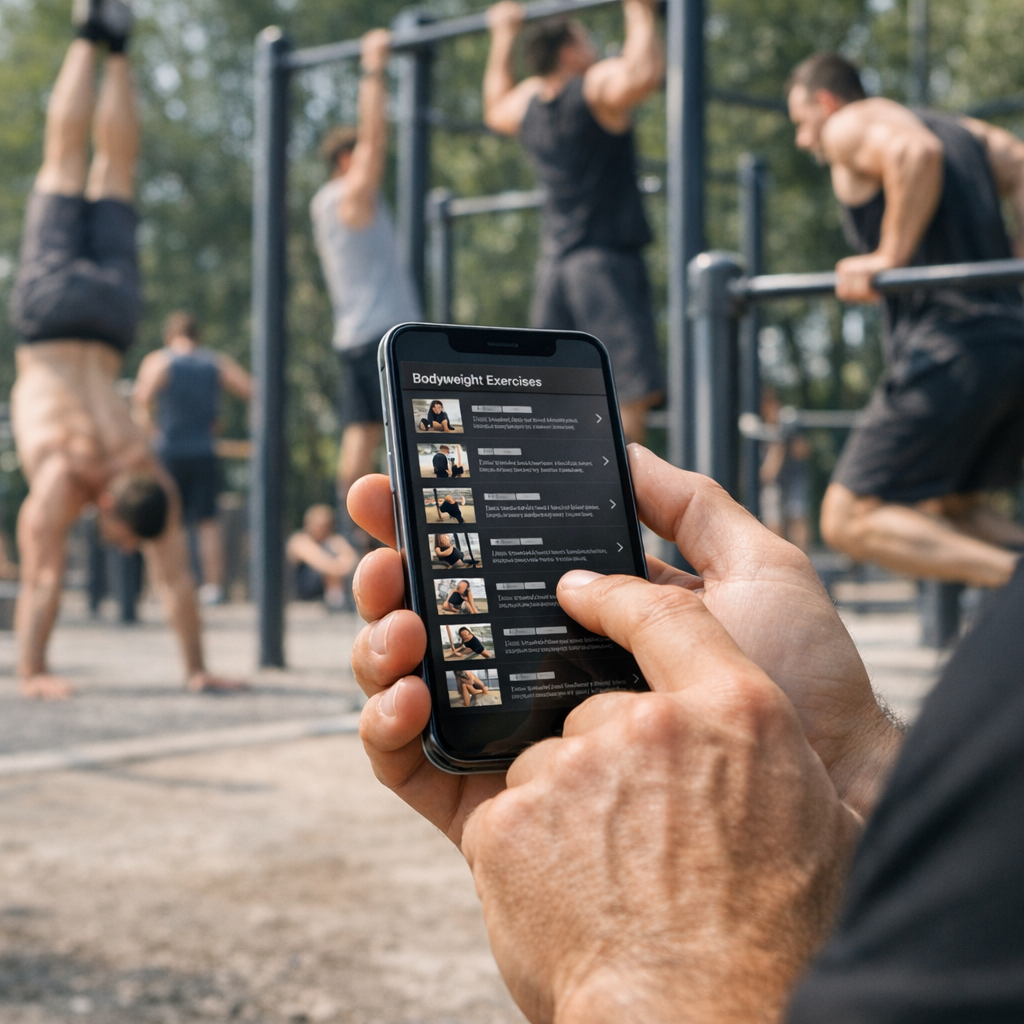
- One of the Largest Calisthenics Libraries: Access a vast range of movements—push, pull, core, explosive, balance, and mobility—with progression options for every skill level.
- Custom Plan Builder: Create your perfect push/pull split, full-body street routine, or skill-based program.
- Detailed Workout Logging: Track sets, reps, weights, distance, and rest—plus add notes for every exercise, variation, and session.
- Progress Photo & Measurement Features: See your evolution in the mirror and the numbers, not just the logbook.
- Personal Motivation Reminders: Set ‘Reasons Why’ notes you’ll see every workout to remind you of your deeper goals.
- Offline and Account-Free: All features work offline, and there’s no need to sign up for core tracking—ideal for privacy-focused athletes.
- Local Storage & Optional Secure Cloud Sync:Your progress is private by default, with easy cloud backup for those who want cross-device access.
- Flexible Premium Options: Start free, then choose $3.99 monthly or $19.99 yearly access, with a limited $39.99 lifetime option for the first 1,000 buyers.
Level Up Your Training: Discover, Track, and Progress
Variety unlocks your best. If you’re ready to break through plateaus and keep your calisthenics journey exciting, explore PumpPal today—download it free and start building bodyweight routines with access to one of the largest calisthenics exercise libraries available.
How to Choose the Right Bodyweight Exercise
Start with the result you want. For strength, choose a variation that allows roughly three to eight controlled repetitions. For muscle growth, use a movement that becomes genuinely challenging before technique breaks down. For skill practice, prioritize crisp repetitions and stop before fatigue changes the position.
Check whether you can control the intended range of motion. If form changes before the target muscles are challenged, select an easier regression. If you can exceed the top of your rep range comfortably, choose a harder leverage, add range of motion, slow the lowering phase, or add external load.
Core Categories Every Calisthenics Library Should Include
A balanced library should cover horizontal and vertical pushing, horizontal and vertical pulling, squat and lunge patterns, posterior-chain work, core training, static holds, mobility, and conditioning. It should also include regressions and progressions for foundational skills such as pull-ups, dips, handstands, pistol squats, L-sits, and muscle-ups.
Beginners do not need dozens of exercises in one session. A practical full-body workout can use one push, one pull, one knee-dominant leg movement, one posterior-chain exercise, and one core or skill movement. Five well-chosen exercises performed consistently are usually more productive than fifteen disconnected movements.
How to Track Progressive Overload in Calisthenics
Bodyweight training still follows progressive overload. Record sets, repetitions, hold duration, external weight or assistance, range of motion, tempo, rest time, and effort. If you complete more repetitions with the same technique and effort, use less assistance, increase range of motion, or hold a harder position for the same duration, you have made measurable progress.
Change one major variable at a time so your workout history remains comparable. Keep main exercises consistent long enough to improve them, then use the library to choose a purposeful next step instead of replacing movements randomly.
What to Look for in a Calisthenics Exercise App
A useful calisthenics app should make training faster, not add friction between sets. Look for searchable exercises, clear movement categories, custom routines, flexible tracking for repetitions and timed holds, workout history, notes, and reliable offline access.PumpPal combines a large bodyweight exercise library with custom plans and detailed workout logging. It works offline and does not require an account for local tracking. Premium access is available for $3.99 per month or $19.99 per year, with a limited $39.99 lifetime option for the first 1,000 buyers.
Frequently Asked Questions
What are the best calisthenics exercises for beginners?
Start with incline or standard push-ups, bodyweight squats, assisted rows or pull-ups, hip bridges, split squats, and planks. Choose versions you can perform through a controlled range of motion and progress gradually.
How many calisthenics exercises should I do per workout?
Most beginners can build an effective full-body session with four to six exercises. More movements are not necessary when the routine already trains pushing, pulling, legs, the posterior chain, and the core.
How often should beginners train calisthenics?
Two or three full-body sessions per week is a practical starting point. Leave enough recovery time between hard sessions and adjust frequency based on soreness, joint comfort, performance, and schedule.
Can you build muscle with only bodyweight exercises?
Yes. Muscle growth requires sufficiently challenging sets, adequate weekly training, progression over time, nutrition, and recovery. Harder leverage, added range, slower tempo, unilateral work, or external load can keep bodyweight exercises challenging.
How do I know when to move to a harder progression?
Advance when you can repeatedly reach the top of your planned repetition or time range with stable technique and a small number of repetitions left in reserve. Test the next step conservatively and return to the easier version if control breaks down.
What is the best calisthenics exercise library app?
The best option combines a broad bodyweight library with custom routines, progression-friendly logging, offline access, and usable workout history. PumpPal includes those tools for iPhone and Android and lets you begin without creating an account.
Build a Library You Will Actually Use
The best calisthenics exercise library is not simply the one with the longest list. It is the one that helps you choose an appropriate movement, repeat it consistently, and recognize when you are ready to progress. Build your routine around a few dependable exercises, use variations with a purpose, and track the details that make each session comparable.