

March in Place exercise
Marching in place is a simple yet effective cardio exercise that elevates the heart rate, improves coordination, and strengthens the legs and core. It’s an excellent warm-up or low-impact movement for beginners and can be done anywhere without equipment.
Updated By PumpPal
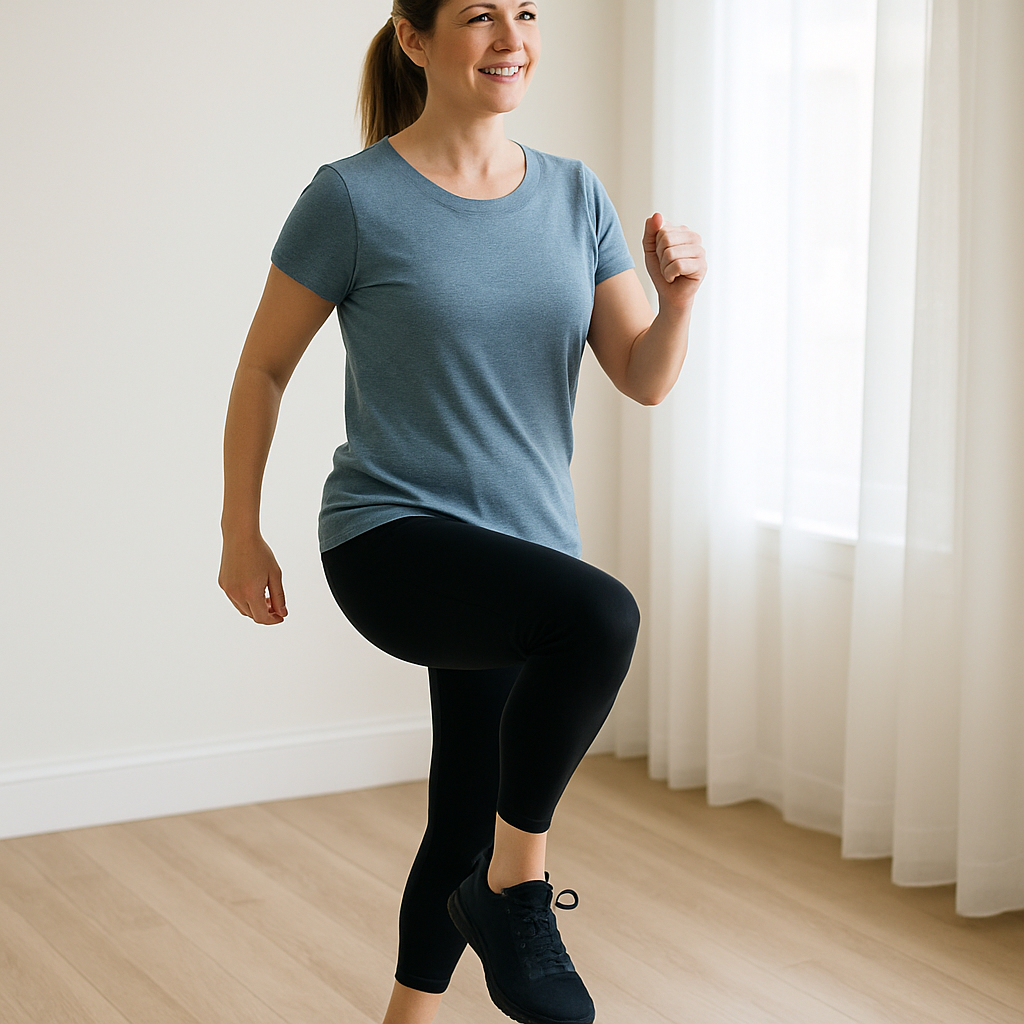
How to perform March in Place
- Stand tall with your feet hip-width apart and arms relaxed at your sides.
- Engage your core and lift your right knee to hip level while swinging your left arm forward.
- Lower your right foot back to the floor and lift your left knee while swinging your right arm forward.
- Continue alternating sides in a smooth, rhythmic motion as if marching.
- Maintain an upright posture and steady breathing throughout the movement.
- March for the desired duration or number of repetitions, gradually increasing your pace for more intensity.
What is March in Place?
Marching in place is a low-impact cardio exercise that alternates lifting one knee while the opposite arm swings forward. It raises the heart rate without requiring travel or equipment, making it useful for warm-ups, short movement breaks, beginner conditioning, and indoor workouts.
What muscles does March in Place work?
The hip flexors lift the knees while the quadriceps, glutes, hamstrings, and calves support each step. The abdominals, obliques, lower-back muscles, shoulders, and arms stabilize the trunk and coordinate the alternating pattern.
March in Place form cues and common mistakes
- Stand tall with the ribs stacked over the pelvis and keep enough clear floor space to step safely.
- Lift one knee to a comfortable height while the opposite arm swings forward, then switch sides smoothly.
- Land quietly through the whole foot instead of stomping or leaning backward to raise the knee higher.
- Maintain a pace that allows steady breathing and an upright posture before adding faster arm action or higher knees.
- Use a wall or sturdy support for balance and stop if you feel chest pain, dizziness, or unusual shortness of breath.
How to add March in Place to a workout
Use marching in place for 2 to 10 minutes as a warm-up or movement break, or complete 3 to 8 intervals of 30 to 90 seconds with easy recovery. Progress by adding time, pace, or arm drive one variable at a time while maintaining low-impact control.
Frequently asked questions
Is marching in place good cardio?
Yes. A continuous, purposeful pace can raise the heart rate and support low-impact aerobic conditioning. The training effect depends on your pace, duration, arm movement, and current fitness level.
What muscles does marching in place work?
It uses the hip flexors, quadriceps, glutes, hamstrings, and calves while the core, lower back, shoulders, and arms stabilize the body and coordinate the alternating pattern.
How long should I march in place?
Beginners can start with 2 to 5 minutes or 30- to 60-second intervals. Build gradually toward longer continuous periods while keeping an upright posture and a pace you can control.
Use controlled movement and an appropriate variation for your current ability. Stop if an exercise causes sharp pain, and seek qualified guidance when needed.