

Step-Up (on box or step) exercise
The step-up is a functional lower-body exercise that targets the quadriceps, glutes, and hamstrings. It mimics the natural movement of climbing stairs and improves balance, coordination, and unilateral leg strength. Using a box, bench, or sturdy platform, step-ups can be performed anywhere with minimal space, making them ideal for home or bodyweight workouts.
Updated By PumpPal
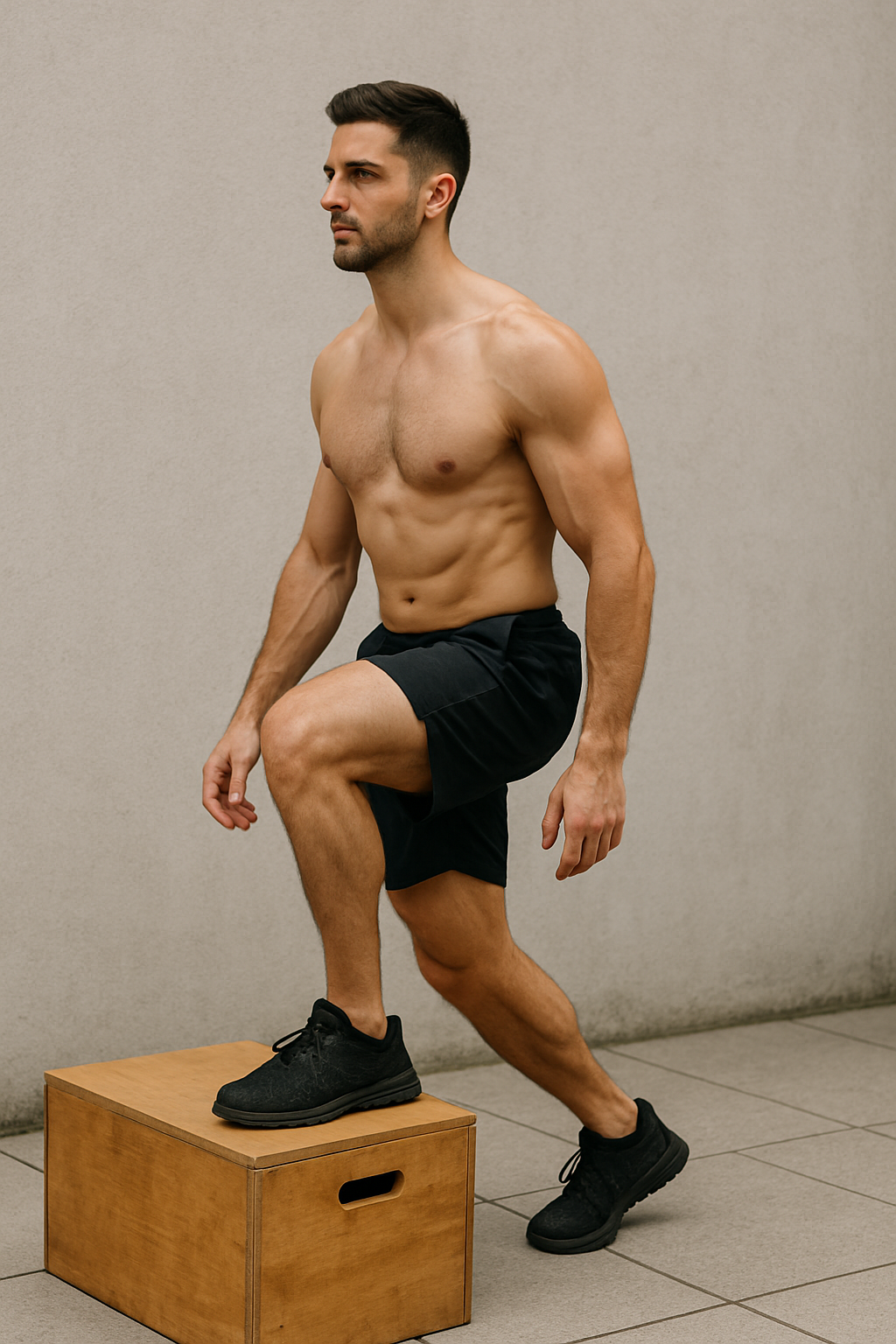
How to perform Step-Up (on box or step)
- Stand upright facing a sturdy box, bench, or step about knee height.
- Place your right foot flat on top of the box, ensuring your entire foot is supported.
- Push through your right heel to lift your body up onto the box, bringing your left foot up to stand fully upright.
- Keep your chest upright and core engaged throughout the movement.
- Step back down with your left foot first, followed by your right foot to return to the starting position.
- Repeat for the desired number of reps, then switch legs.
- Avoid pushing off the ground with your back leg—focus on driving with the lead leg.
What is Step-Up (on box or step)?
The bodyweight step-up is a unilateral lower-body exercise performed by placing one foot on a stable step or box and driving through that leg to stand on top. It trains stair-climbing strength and balance without the added loading used in a dumbbell step-up.
What muscles does Step-Up (on box or step) work?
The quadriceps and gluteus maximus extend the lead knee and hip, with the hamstrings and calves assisting. The gluteus medius, adductors, foot muscles, abdominal wall, and lower back stabilize the knee, pelvis, and trunk.
Step-Up (on box or step) form cues and common mistakes
- Choose a rigid, nonslip platform low enough that the lead foot stays flat and the pelvis remains level.
- Place the entire lead foot on the step, brace the trunk, and keep the knee tracking in the same direction as the toes.
- Drive through the lead foot and minimize the push from the trailing leg so the working side does the lift.
- Stand tall at the top without leaning backward, then lower under control instead of dropping to the floor.
- Use a railing or stable support and reduce the step height if balance breaks, the knee collapses inward, or pain appears.
How to add Step-Up (on box or step) to a workout
Use bodyweight step-ups as a lower-body strength exercise or in a conditioning circuit. Start with 2 to 4 sets of 6 to 15 repetitions per leg. Progress with cleaner control, a slightly higher step, or a slower lowering phase before adding dumbbells.
Frequently asked questions
What muscles do bodyweight step-ups work?
They primarily train the quadriceps and glutes, with the hamstrings and calves assisting. The outer hip, inner thigh, foot, core, and lower-back muscles help stabilize the knee and pelvis.
How high should the box be for step-ups?
Start with a height that lets the whole foot stay supported and the lead thigh remain below or near parallel without the pelvis tucking or the knee collapsing inward. A lower step is usually easier to control.
What is the difference between a bodyweight and dumbbell step-up?
The movement pattern is similar, but a dumbbell step-up adds external load. Master balance, full-foot pressure, and a controlled descent with bodyweight before adding weights.
Use controlled movement and an appropriate variation for your current ability. Stop if an exercise causes sharp pain, and seek qualified guidance when needed.