

Plank Jacks exercise
Plank jacks are a cardio-core hybrid exercise that combines the stability of a plank with the agility of jumping jacks. This bodyweight movement strengthens the core, shoulders, chest, glutes, and legs while improving endurance and coordination. It’s perfect for full-body conditioning and fat-burning routines.
Updated By PumpPal Editorial standards
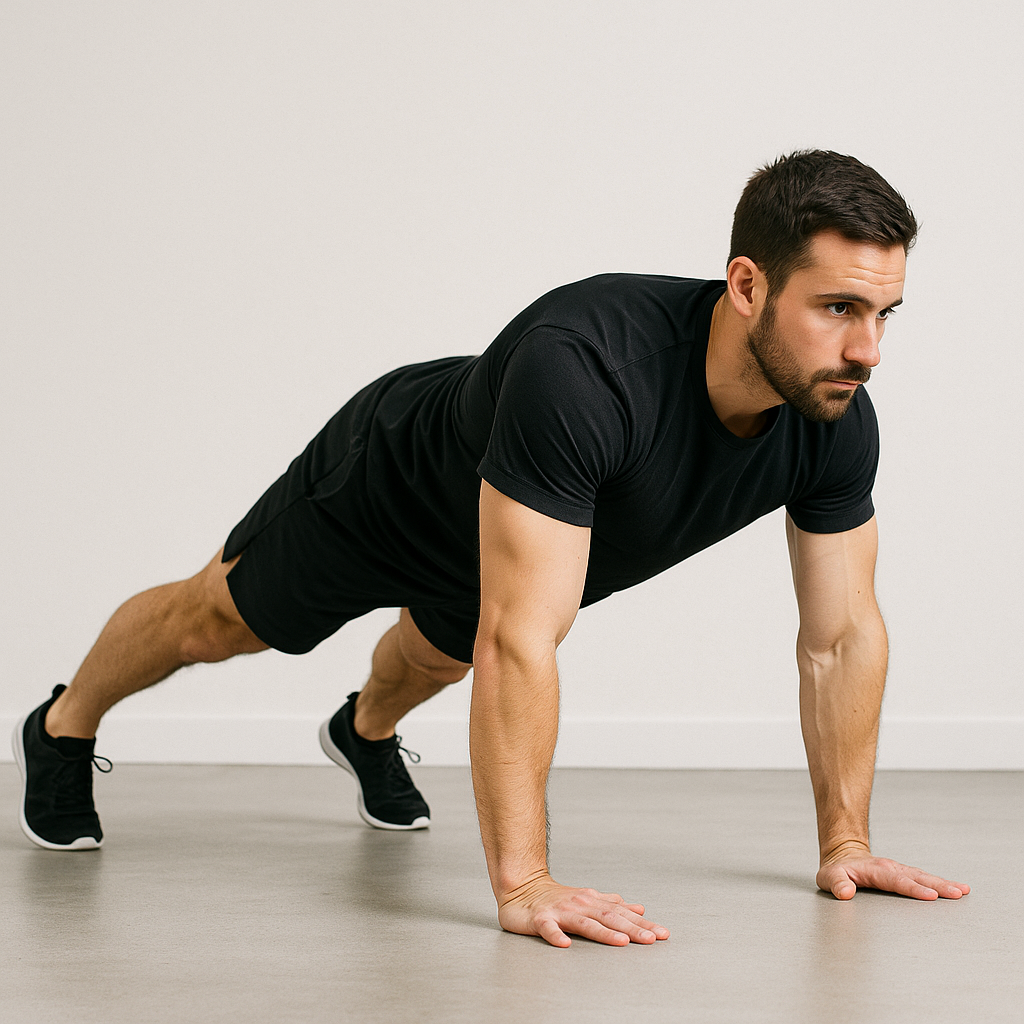
How to perform Plank Jacks
- Start in a high plank position with your hands directly under your shoulders and your body in a straight line.
- Engage your core and keep your legs extended with feet together.
- Jump your feet apart to the sides while keeping your upper body stable.
- Quickly jump your feet back together to return to the starting position.
- Continue jumping your feet in and out in a steady rhythm.
- Keep your hips level and avoid bouncing or sagging your lower back.
- Repeat for the desired time or number of reps.
What is Plank Jacks?
A plank jack combines a high-plank hold with repeated jumps of the feet apart and back together. The upper body stays planted while the legs move, creating a conditioning drill that challenges trunk control, shoulder endurance, and coordination.
What muscles does Plank Jacks work?
The abdominal wall, obliques, and spinal stabilizers resist sagging and rotation. The shoulders, serratus anterior, chest, and triceps support the high plank, while the glutes, outer hips, inner thighs, quadriceps, hamstrings, and calves move and control the legs.
Plank Jacks form cues and common mistakes
- Set the hands under or slightly outside the shoulders, spread the fingers, and begin with a straight line from the head through the heels.
- Brace the abdomen and glutes before the first jump so the hips remain level instead of bouncing, sagging, or lifting sharply with each repetition.
- Jump the feet only as wide as you can control, land softly on the balls of the feet, and keep the knees tracking comfortably with the toes.
- Keep pressing the floor away and avoid letting the shoulders collapse toward the ears as breathing and leg speed increase.
- Use alternating step-outs instead of jumps for a lower-impact option, and stop for sharp wrist, shoulder, back, hip, knee, ankle, or foot pain.
How to add Plank Jacks to a workout
Use plank jacks as a short conditioning interval or a dynamic core accessory. Start with 2 to 4 sets of 15 to 30 seconds, or 8 to 20 controlled out-and-in repetitions, resting long enough to restore a stable plank. Increase duration or repetitions before increasing speed, and switch to step-outs when impact or trunk control becomes the limiting factor.
Frequently asked questions
What muscles do plank jacks work?
They challenge the abdominals, obliques, and spinal stabilizers while the shoulders, serratus, chest, and triceps support the plank. The glutes, hips, thighs, hamstrings, and calves move and control the legs.
How do I do plank jacks without jumping?
Hold a high plank and step one foot out to the side, return it, then repeat with the other foot. Keep the hips level and alternate sides at a pace you can control.
How many plank jacks should I do?
Start with 15 to 30 seconds or 8 to 20 complete out-and-in repetitions for 2 to 4 sets. End the set when the hips sag, the shoulders collapse, or the landings become hard and uncontrolled.
Use controlled movement and an appropriate variation for your current ability. Stop if an exercise causes sharp pain, and seek qualified guidance when needed.