

Russian Twists exercise
Russian twists are a core exercise that targets the obliques and rectus abdominis, improving rotational strength and core stability. Performed in a seated position with a twisting motion from side to side, this bodyweight exercise engages multiple core muscles and can be performed with or without added resistance, making it ideal for both beginners and advanced athletes.
Updated By PumpPal
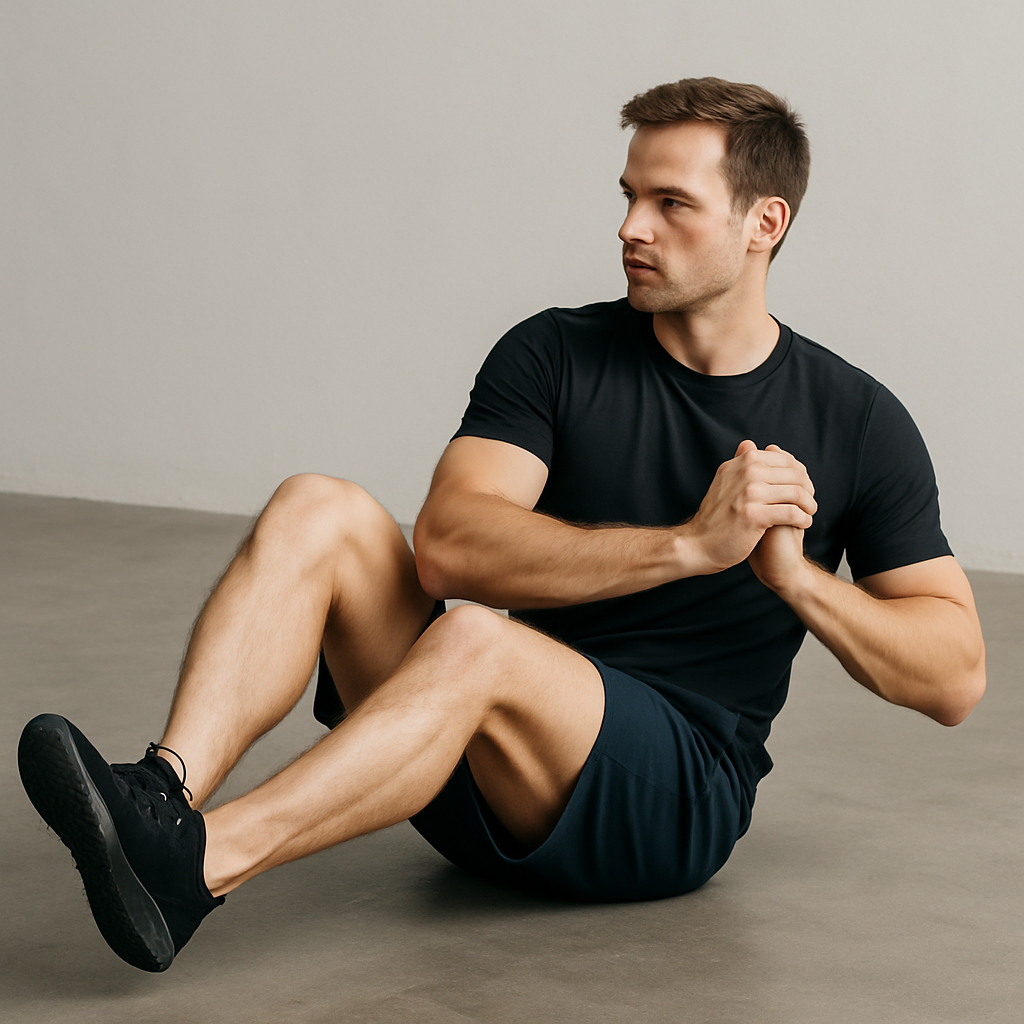
How to perform Russian Twists
- Sit on the floor with your knees bent and feet flat, leaning back slightly to engage your core.
- Lift your feet off the floor so your shins are parallel to the ground, balancing on your glutes.
- Clasp your hands together in front of your chest or hold a weight for added resistance.
- Rotate your torso to the right, bringing your hands beside your hip.
- Return to the center, then twist to the left side in a controlled motion.
- Continue alternating sides, keeping your abs tight and movements slow and steady.
- Avoid using momentum; focus on rotating through your core.
What is Russian Twists?
The Russian twist is a seated rotational core exercise performed while the torso leans back and turns from side to side. The goal is to rotate the rib cage under control while the pelvis stays comparatively steady, not simply swing the hands across the body.
What muscles does Russian Twists work?
The obliques produce and control trunk rotation, while the rectus abdominis and deeper core resist excessive extension. The hip flexors, spinal stabilizers, glutes, upper back, shoulders, and arms help maintain the seated position and any external load.
Russian Twists form cues and common mistakes
- Sit tall with the knees bent and lean back only until the abdomen can hold the torso without the lower back collapsing; keep the feet grounded if balance or back control is limited.
- Brace the abdomen, keep the chest open, and rotate the ribs and shoulders together instead of reaching the hands side to side while the torso stays still.
- Use a comfortable range that keeps the pelvis mostly steady and the movement smooth; touching the floor is not required.
- Move slowly enough to stop at each side without momentum, and keep any plate, ball, or dumbbell close to the chest before extending it farther away.
- Reduce the lean, keep both feet down, remove the load, or choose an anti-rotation exercise if the lower back or hip flexors dominate, and stop for sharp back, hip, or abdominal pain.
How to add Russian Twists to a workout
Begin with bodyweight Russian twists for 2 to 4 sets of 6 to 15 controlled rotations per side, leaving 2 to 3 reps in reserve. Increase clean repetitions before lifting the feet, extending the arms, or adding a small external load.
Frequently asked questions
What muscles do Russian twists work?
They emphasize the internal and external obliques while the rectus abdominis, deep core, spinal stabilizers, hip flexors, glutes, upper back, shoulders, and arms help hold and rotate the position.
Should my feet be up or down during Russian twists?
Either can be valid, but keeping the feet down provides more stability and is often the better starting point. Lift the feet only when you can keep the lower back controlled and rotate without swinging.
Are Russian twists bad for the lower back?
They are not appropriate for everyone. Excessive leaning, rounding, momentum, load, or forced range can irritate the back. Use a smaller controlled range or choose a different core exercise if twisting causes pain.
Use controlled movement and an appropriate variation for your current ability. Stop if an exercise causes sharp pain, and seek qualified guidance when needed.