

Single-Leg Deadlift (no weight) exercise
The single-leg deadlift is a bodyweight exercise that targets the hamstrings, glutes, and lower back while enhancing balance, coordination, and core stability. By standing on one leg and hinging at the hips, you isolate each side of the posterior chain and improve functional strength. This movement also activates stabilizer muscles and is excellent for injury prevention and athletic performance.
Updated By PumpPal
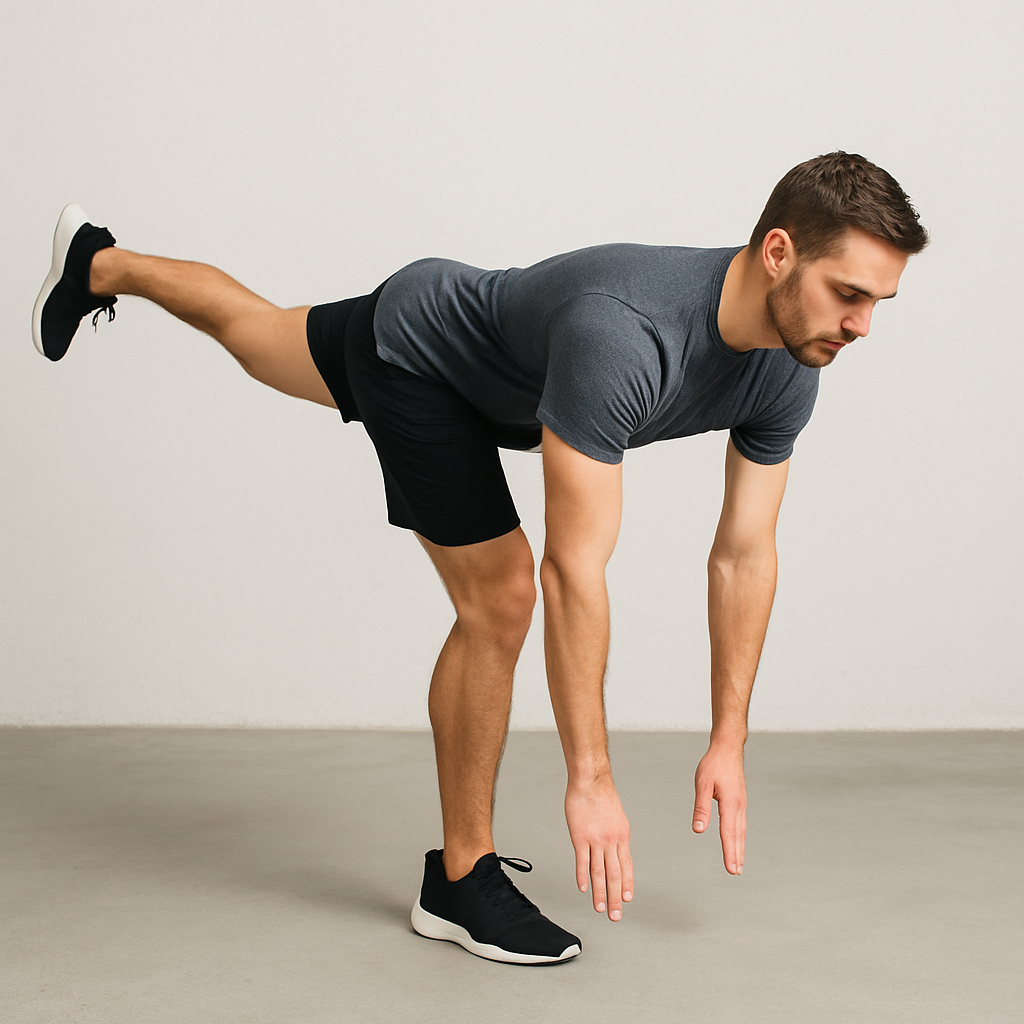
How to perform Single-Leg Deadlift (no weight)
- Stand upright with your feet hip-width apart and arms at your sides.
- Shift your weight onto your left foot and slightly bend your left knee.
- Hinge forward at the hips, extending your right leg straight back behind you.
- Keep your back flat and your torso moving as one unit with your leg as a counterbalance.
- Reach your hands toward the floor as your upper body lowers and your right leg rises.
- Stop when your torso is parallel to the floor or as far as your flexibility allows.
- Return to the starting position by driving through your left heel and lowering your right leg with control.
- Repeat all reps on one side before switching legs.
What is Single-Leg Deadlift (no weight)?
The bodyweight single-leg deadlift is a hip-hinge exercise performed while balancing on one leg. The torso tips forward as the free leg reaches back, creating a long counterbalanced line while the standing hip controls the descent and return without added weight.
What muscles does Single-Leg Deadlift (no weight) work?
The gluteus maximus and hamstrings extend the standing hip. The gluteus medius, adductors, calves, foot muscles, spinal erectors, and abdominal wall stabilize the pelvis, ankle, and trunk throughout the hinge.
Single-Leg Deadlift (no weight) form cues and common mistakes
- Stand beside a wall or sturdy support if balance limits your ability to practice the hip hinge.
- Keep a tripod foot with pressure through the heel, base of the big toe, and base of the little toe.
- Soften the standing knee, push the hips backward, and let the torso and free leg move as one unit.
- Keep both hip bones facing the floor instead of opening the free-leg side to gain extra range.
- Stop before the back rounds or balance breaks, then drive the standing foot down to return with control.
How to add Single-Leg Deadlift (no weight) to a workout
Use bodyweight single-leg deadlifts in a warm-up, lower-body workout, or balance circuit. Start with 2 to 4 sets of 6 to 12 repetitions per side. Progress by increasing controlled range, pausing near the bottom, or adding a light load only after both sides are steady.
Frequently asked questions
What muscles do bodyweight single-leg deadlifts work?
They emphasize the glutes and hamstrings of the standing leg. The outer hip, inner thigh, calf, foot, lower back, and abdominal muscles help stabilize the pelvis and maintain balance.
How do I improve balance during a single-leg deadlift?
Use light fingertip support, keep pressure across the whole standing foot, and shorten the range. Move slowly and keep the hips square before trying deeper unsupported repetitions.
Should the knee bend during a single-leg deadlift?
Keep a small, stable bend in the standing knee rather than locking it or turning the movement into a squat. Most of the motion should come from pushing the hips backward.
Use controlled movement and an appropriate variation for your current ability. Stop if an exercise causes sharp pain, and seek qualified guidance when needed.