

Y-T-W Raises exercise
A series of prone raises to target upper back and shoulder health.
Updated By PumpPal
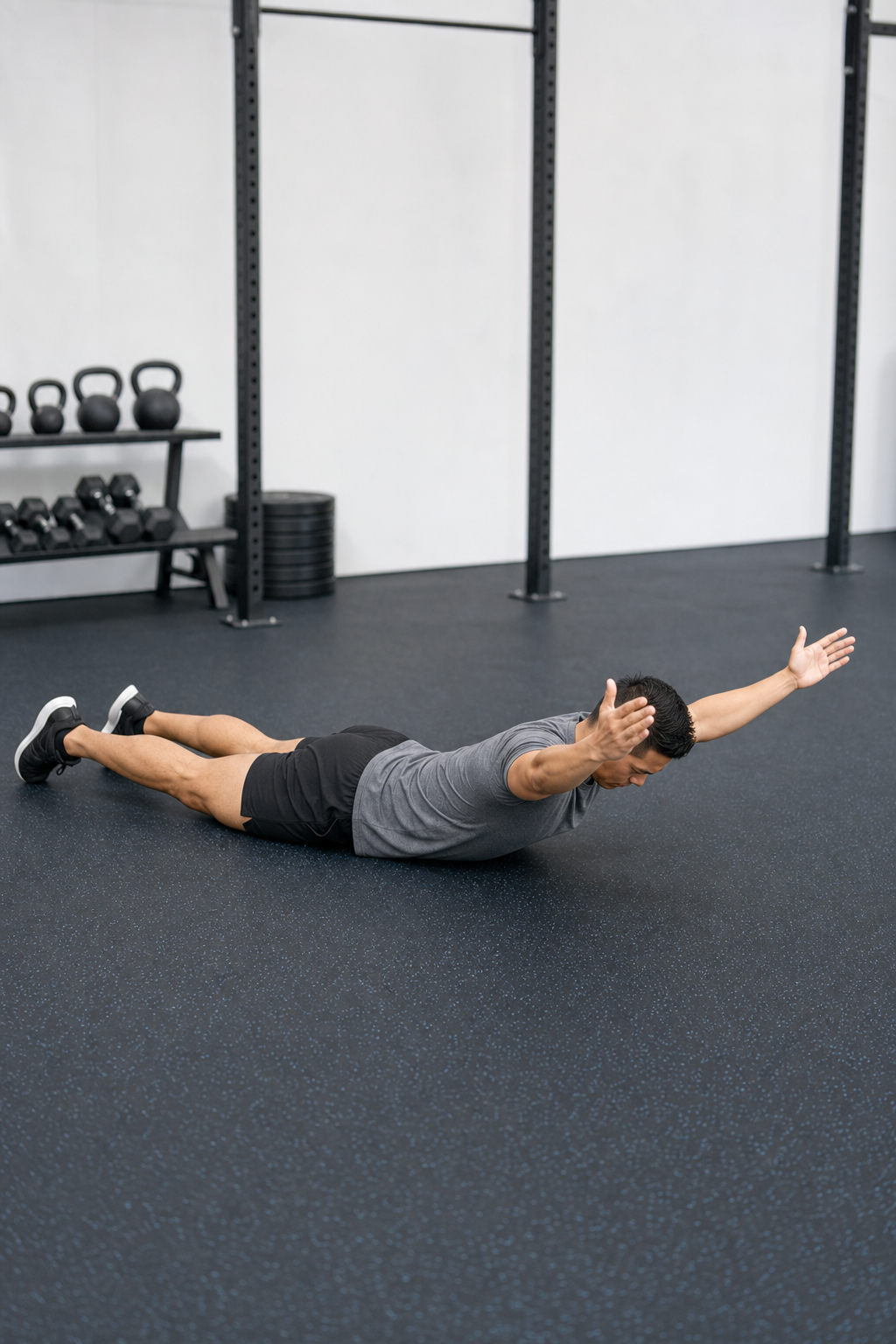
How to perform Y-T-W Raises
- Lie face down with arms extended overhead.
- Raise arms in 'Y', then lower.
- Raise arms out to 'T', then lower.
- Raise arms bent at elbows to 'W', then lower.
- Repeat sequence for desired reps.
What is Y-T-W Raises?
Y-T-W raises are a sequence of light prone shoulder raises performed with the arms in three shapes: overhead in a Y, straight out in a T, and bent into a W. The goal is controlled shoulder-blade movement and upper-back endurance, not lifting the arms as high as possible.
What muscles does Y-T-W Raises work?
The sequence trains the lower and middle trapezius, rhomboids, rear deltoids, and rotator-cuff muscles. The spinal extensors and core help hold the torso steady while each arm position emphasizes a slightly different pattern of shoulder-blade control.
Y-T-W Raises form cues and common mistakes
- Lie face down with the neck long and eyes toward the floor so the head does not lift to create false range.
- Reach the arms long in each letter position and move from the shoulders rather than bending and straightening the elbows for momentum.
- Lift only to the height you can control without shrugging, pinching the shoulders, or arching the lower back.
- Pause briefly in the Y, T, and W positions and lower the arms fully between shapes instead of rushing the sequence.
- Begin without weight; if more resistance is appropriate later, use very light loads while preserving the same smooth shoulder-blade motion.
How to add Y-T-W Raises to a workout
Use Y-T-W raises in an upper-body warm-up or as a light upper-back accessory. Start with 2 to 3 sets of 5 to 10 complete sequences, counting one Y, one T, and one W as a cycle. Use a one- or two-second pause and stop before the neck or lower back begins to compensate.
Frequently asked questions
What muscles do Y-T-W raises work?
They primarily train the lower and middle trapezius, rhomboids, rear deltoids, and rotator-cuff muscles. The spinal extensors and core also help keep the torso stable.
Should I use weights for Y-T-W raises?
Start without weight and learn to move the shoulder blades without shrugging or arching. If bodyweight becomes easy, very light weights may be enough because the long arm positions create substantial leverage.
How many Y-T-W raises should I do?
Begin with 2 to 3 sets of 5 to 10 complete Y-T-W cycles. Move slowly, pause briefly in each position, and stop the set when you cannot keep the neck and lower back relaxed.
Use controlled movement and an appropriate variation for your current ability. Stop if an exercise causes sharp pain, and seek qualified guidance when needed.