

Bulgarian Push-Up exercise
A push-up with feet elevated on a bench or step, increasing range of motion and chest activation.
Updated By PumpPal
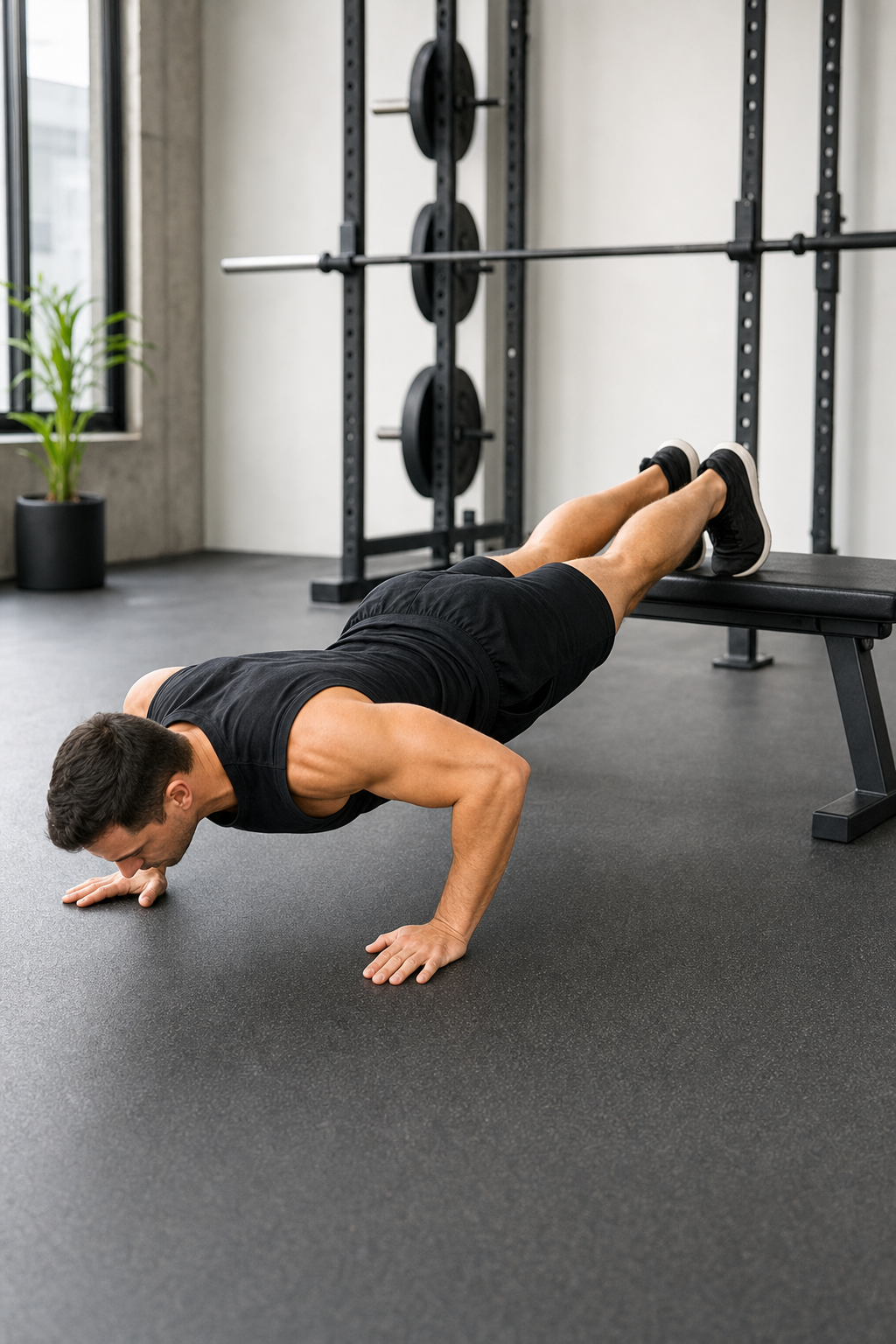
How to perform Bulgarian Push-Up
- Place feet on a bench or elevated surface.
- Hands on the ground, shoulder-width apart.
- Lower your chest toward the floor.
- Pause at the bottom for control.
- Push back up to starting position.
- Repeat for the desired reps.
What is Bulgarian Push-Up?
In PumpPal's exercise library, the Bulgarian push-up is a feet-elevated push-up performed with the toes on a bench or step and the hands on the floor. Elevating the feet shifts more bodyweight toward the upper body and makes the press harder than a standard floor push-up.
What muscles does Bulgarian Push-Up work?
The chest, triceps, and front deltoids perform the press, with the higher foot position generally increasing shoulder demand. The serratus anterior, upper back, abdominal wall, glutes, and legs stabilize the shoulder blades and maintain a rigid plank.
Bulgarian Push-Up form cues and common mistakes
- Use a stable, non-slip bench or step and begin with a modest elevation before progressing to a higher surface.
- Place the hands firmly on the floor, brace the abdomen and glutes, and keep one straight line from the shoulders through the heels.
- Lower the chest between the hands with the elbows at a comfortable angle rather than flaring them directly sideways.
- Press the floor away without leading with the head, letting the hips sag, or turning the repetition into a pike push-up.
- Lower the foot elevation or use a standard push-up if you cannot maintain the same body line and range from the first rep to the last.
How to add Bulgarian Push-Up to a workout
Use Bulgarian push-ups as a harder horizontal-press variation after you can perform standard push-ups with consistent form. Begin with 3 to 4 sets of 5 to 12 repetitions. Add repetitions before raising the feet, and change only one progression variable at a time.
Frequently asked questions
What is a Bulgarian push-up?
In this variation, the feet rest on a stable bench or step while the hands remain on the floor. The elevated position shifts more bodyweight toward the hands and increases the difficulty of the push-up.
Are Bulgarian push-ups the same as decline push-ups?
The names are often used for a similar feet-elevated push-up. Exercise naming varies, so the important details are the actual setup, foot height, body line, and range of motion rather than the label.
How high should my feet be for Bulgarian push-ups?
Start with a low, stable step or bench that lets you keep a straight body line. A higher surface is not automatically better; reduce the height if the hips sag, shoulders shrug, or range becomes inconsistent.
Use controlled movement and an appropriate variation for your current ability. Stop if an exercise causes sharp pain, and seek qualified guidance when needed.