

Deficit Handstand Push-Up exercise
A handstand push-up where hands are elevated to increase range of motion and shoulder challenge.
Updated By PumpPal
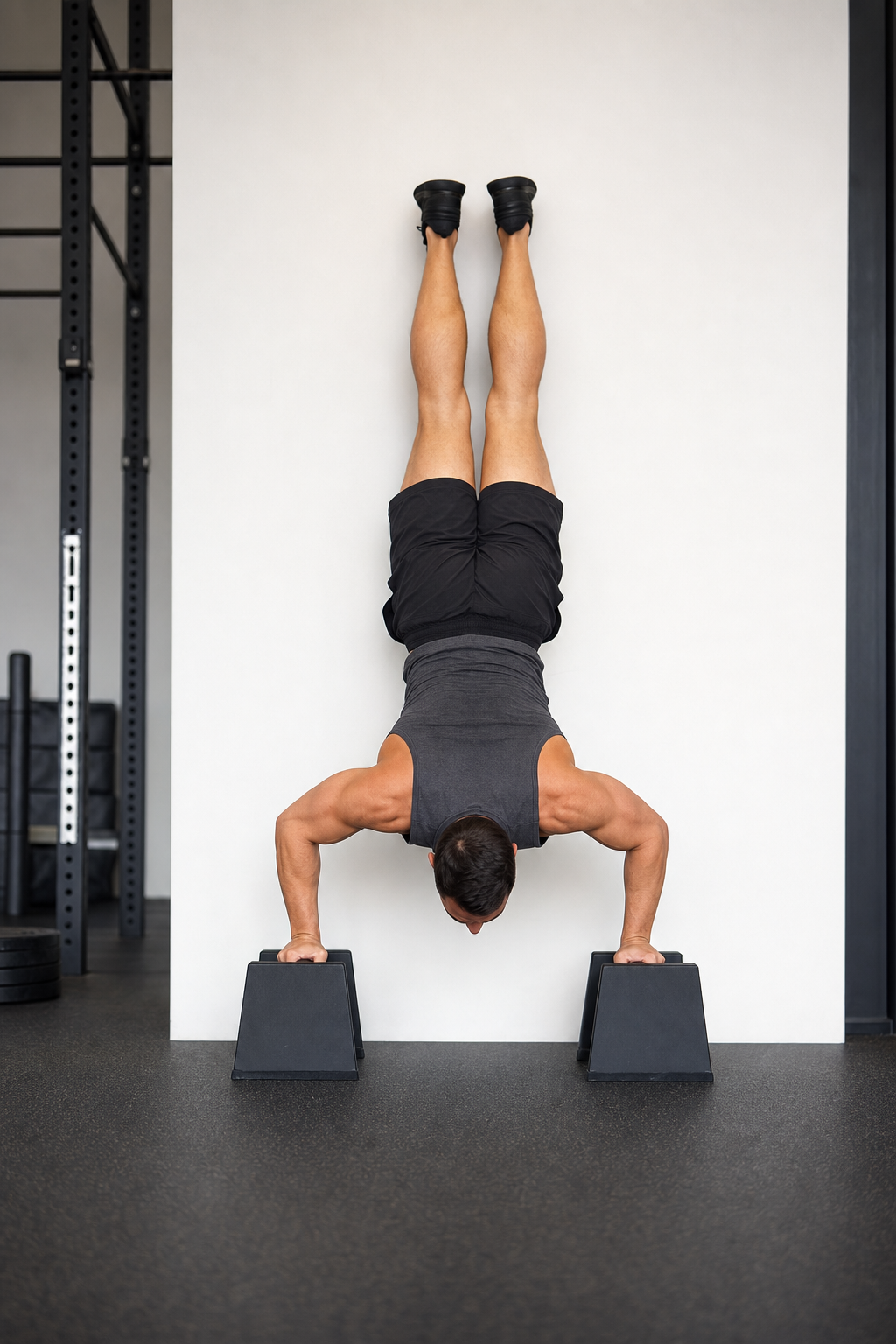
How to perform Deficit Handstand Push-Up
- Place your hands on sturdy, elevated objects shoulder-width apart.
- Kick or press into a handstand with feet against a wall for support.
- Keep your core engaged and body straight.
- Lower your head below hand level by bending your elbows.
- Pause briefly, then press back up.
- Return to the handstand and repeat.
What is Deficit Handstand Push-Up?
The deficit handstand push-up is an advanced inverted press performed with the hands on equal-height supports so the head and shoulders can descend below hand level. The longer range increases pressing demand and should be added only after a standard wall handstand push-up is controlled.
What muscles does Deficit Handstand Push-Up work?
The shoulders and triceps are the primary movers, with the upper chest and upper back assisting the press. The hands, forearms, rotator cuff, serratus anterior, abdominal wall, glutes, and legs stabilize the inverted body and support a controlled path.
Deficit Handstand Push-Up form cues and common mistakes
- Use two sturdy, equal-height, non-slip supports and clear the landing area before entering the handstand.
- Choose a wall-assisted setup and exit you can repeat safely; leave enough strength to come down under control.
- Press through the hands, keep the shoulders active, and brace the abdomen and glutes to limit excessive back arching.
- Lower slowly between the supports with a comfortable elbow path, using only the depth you can reverse without collapsing onto the head or neck.
- Reduce the deficit, shorten the range, or return to pike and standard handstand push-ups if the supports shift, the line breaks, or the press stalls.
How to add Deficit Handstand Push-Up to a workout
Practice deficit handstand push-ups early in a skill or pressing session after warming the wrists and shoulders. Start with 3 to 5 sets of 1 to 5 controlled wall-assisted repetitions using a small deficit. Increase range only after the current depth is repeatable with a safe exit.
Frequently asked questions
What is a deficit handstand push-up?
It is a handstand push-up performed with the hands on raised supports, allowing the head and shoulders to travel below hand level. That longer range makes it harder than a standard handstand push-up.
How deep should a deficit handstand push-up be?
Use only the depth you can control and press from without loading the head or losing body alignment. Start with a small deficit and increase it gradually rather than chasing maximum depth.
What should I master before deficit handstand push-ups?
You should have a stable wall handstand, active shoulder support, a controlled standard wall handstand push-up, and a reliable exit. Pike push-ups and partial-range repetitions are useful earlier progressions.
Use controlled movement and an appropriate variation for your current ability. Stop if an exercise causes sharp pain, and seek qualified guidance when needed.