

Korean Dips exercise
An advanced dip variation performed behind a straight bar, targeting chest, triceps, and shoulders while requiring significant shoulder mobility.
Updated By PumpPal
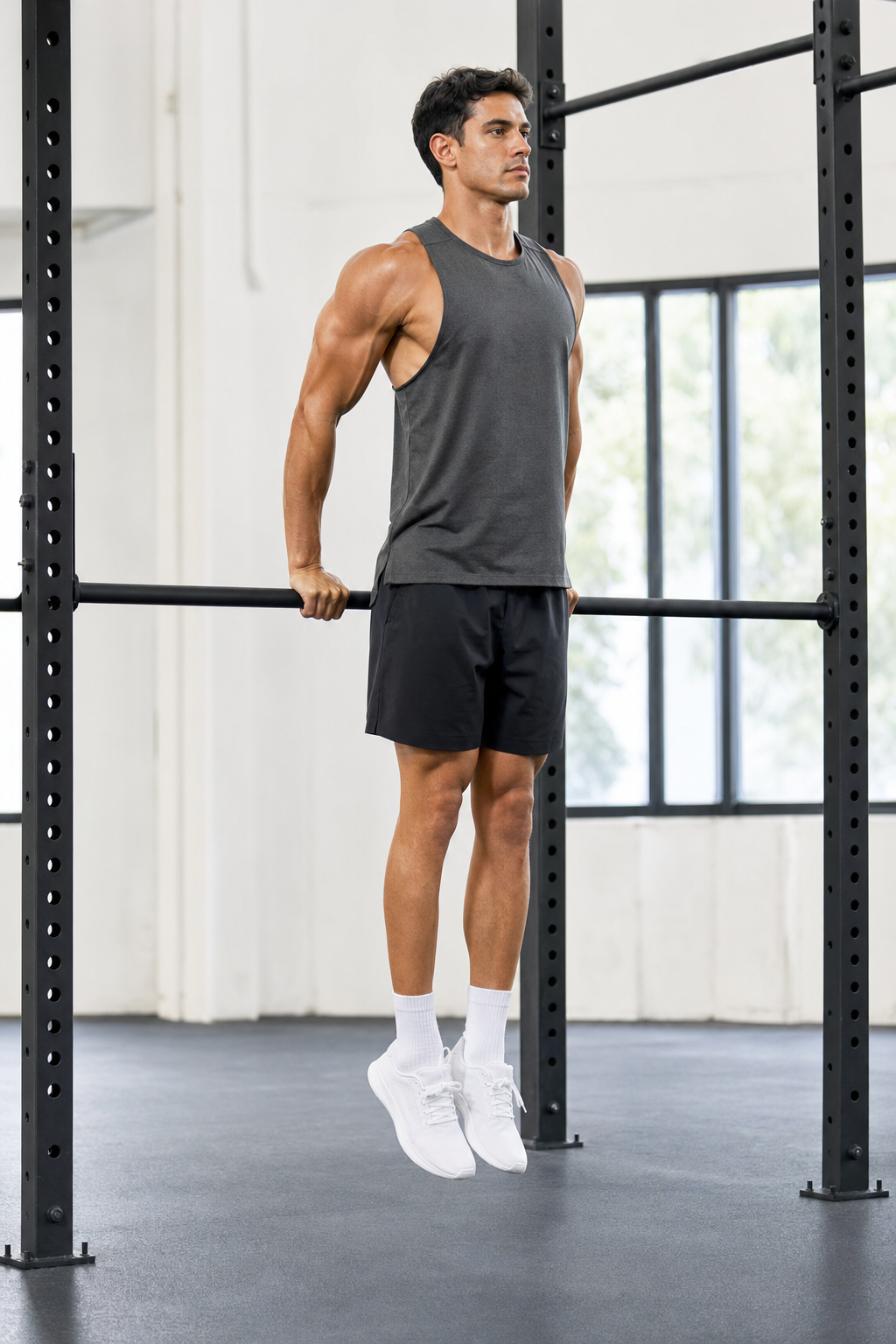
How to perform Korean Dips
- Grip a straight bar behind your back with both hands.
- Jump or muscle up to lockout in the dip position behind the bar.
- Lower your body by bending your elbows, keeping your torso upright.
- Dip down until your shoulders are below the bar.
- Press back up to full extension.
- Repeat for desired reps.
What is Korean Dips?
The Korean dip is an advanced straight-bar dip performed with the bar behind the body. It requires substantial shoulder extension, a secure support position, and controlled pressing strength through a range that is much less forgiving than parallel-bar dips.
What muscles does Korean Dips work?
The triceps, chest, and front deltoids produce the press. The rear deltoids, lats, rotator cuff, upper back, forearms, hands, abdominal wall, glutes, and spinal stabilizers control the bar and body behind it.
Korean Dips form cues and common mistakes
- Use a fixed straight bar with clear space below, master pain-free straight-bar and parallel-bar dips first, and use a low bar or spotter for early practice.
- Establish a stable top support with both hands gripping firmly behind the hips, elbows straight, shoulders controlled, and the body motionless.
- Lower slowly by bending the elbows while keeping the bar close and using only the shoulder-extension range you can control without forcing the chest forward.
- Press back to a secure support without bouncing, swinging the legs, dropping suddenly below the bar, or snapping the elbows straight.
- Stop immediately for shoulder, chest, sternum, elbow, wrist, or hand pain; use bench or straight-bar dip progressions if the behind-body position is not comfortable.
How to add Korean Dips to a workout
Treat Korean dips as an advanced skill while fresh, not as high-fatigue volume. Begin with 3 to 5 sets of 1 to 5 controlled repetitions, leaving at least 2 reps in reserve. Increase range only after every repetition returns to a stable top support.
Frequently asked questions
What muscles do Korean dips work?
They train the triceps, chest, and front shoulders while the lats, rear shoulders, rotator cuff, upper back, grip, core, and glutes stabilize the behind-body support.
Why are Korean dips difficult?
The bar sits behind the body, which demands more shoulder extension, control, and confidence than ordinary parallel-bar dips. The entry, balance, and return to support also require advanced strength.
How should I progress to Korean dips?
Build pain-free parallel-bar dips, straight-bar dips, support holds, and carefully controlled bench-dip range first. Use a low fixed bar and partial range before attempting deeper repetitions.
Use controlled movement and an appropriate variation for your current ability. Stop if an exercise causes sharp pain, and seek qualified guidance when needed.