

Side Plank exercise
The side plank is an isometric core exercise that targets the obliques, shoulders, and hip stabilizers. It improves core strength, balance, and spinal alignment, making it an essential movement for functional fitness and injury prevention. The side plank also enhances lateral stability, which is often undertrained in standard core routines.
Updated By PumpPal
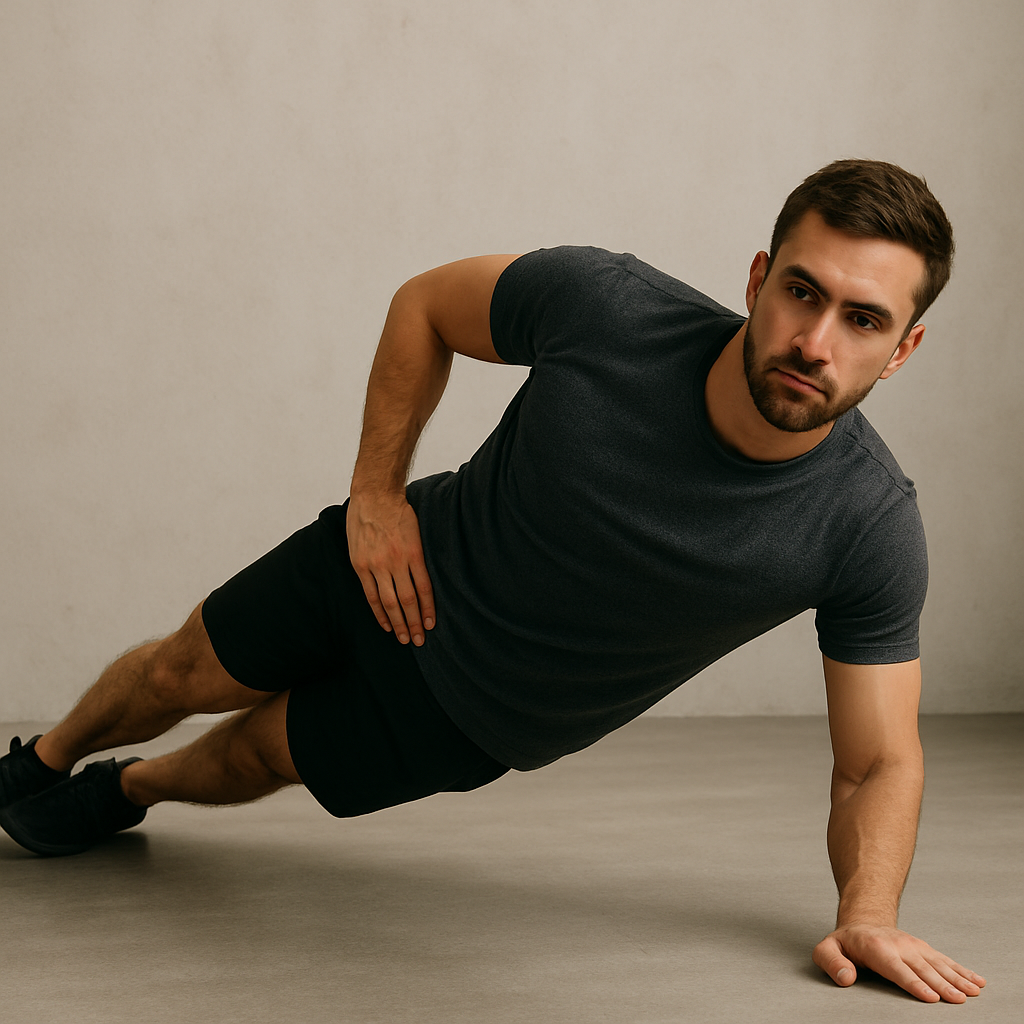
How to perform Side Plank
- Lie on your side with your legs extended and stacked on top of each other.
- Place your bottom elbow directly beneath your shoulder, forearm flat on the ground.
- Engage your core and lift your hips off the ground, forming a straight line from head to heels.
- Keep your top hand on your hip or extended straight up for balance.
- Maintain the position, keeping your hips lifted and your body aligned.
- Hold for the desired duration, then switch to the opposite side.
- Avoid letting your hips sag and keep your neck in a neutral position.
What is Side Plank?
The side plank is a static lateral core exercise performed while supporting the body on one forearm or hand and the side of the feet. Holding the head, trunk, hips, and legs in one line trains the body to resist sideways bending and rotation.
What muscles does Side Plank work?
The obliques, deep abdominal muscles, quadratus lumborum, and glute medius keep the hips lifted and trunk aligned. The supporting shoulder, serratus anterior, upper back, forearm, adductors, glutes, quadriceps, and calves stabilize the position.
Side Plank form cues and common mistakes
- Place the supporting elbow directly below the shoulder, press the forearm into the floor, and keep the shoulder active rather than sinking toward the ear.
- Stack the feet for a harder balance challenge or stagger them for a wider base, then lift the hips until the head, ribs, pelvis, knees, and ankles form one line.
- Keep the chest and hips stacked instead of rotating toward the floor or ceiling, and lightly brace the abdomen and glutes without holding your breath.
- End the hold when the hips sag, the supporting shoulder collapses, or the body twists; shorter repeatable holds are more useful than extending time with poor alignment.
- Place the lower knee on the floor to regress, use padding under the forearm if needed, and stop for sharp shoulder, elbow, neck, back, hip, or knee pain.
How to add Side Plank to a workout
Use side planks as a core accessory after compound lifts or in a warm-up when the holds stay submaximal. Start with 2 to 4 sets of 15 to 45 seconds per side, leaving several controlled seconds in reserve. Add time before progressing to dynamic or loaded variations.
Frequently asked questions
What muscles does a side plank work?
Side planks emphasize the obliques, deep abdominal muscles, quadratus lumborum, and glute medius. The supporting shoulder, serratus, upper back, forearm, inner thighs, glutes, quadriceps, and calves also stabilize the hold.
How long should I hold a side plank?
Beginners can start with repeatable 15- to 30-second holds per side. Build toward about 30 to 60 seconds only while the hips stay lifted, the shoulder remains active, and breathing stays controlled.
How can I make a side plank easier?
Bend the lower knee and keep it on the floor, stagger the feet, or shorten the hold. Keep the supporting elbow below the shoulder and use enough assistance to maintain a straight, stacked body position.
Use controlled movement and an appropriate variation for your current ability. Stop if an exercise causes sharp pain, and seek qualified guidance when needed.