

Weighted Deficit Push-Up exercise
A push-up with hands on raised surfaces and weight added, allowing for a deeper stretch.
Updated By PumpPal
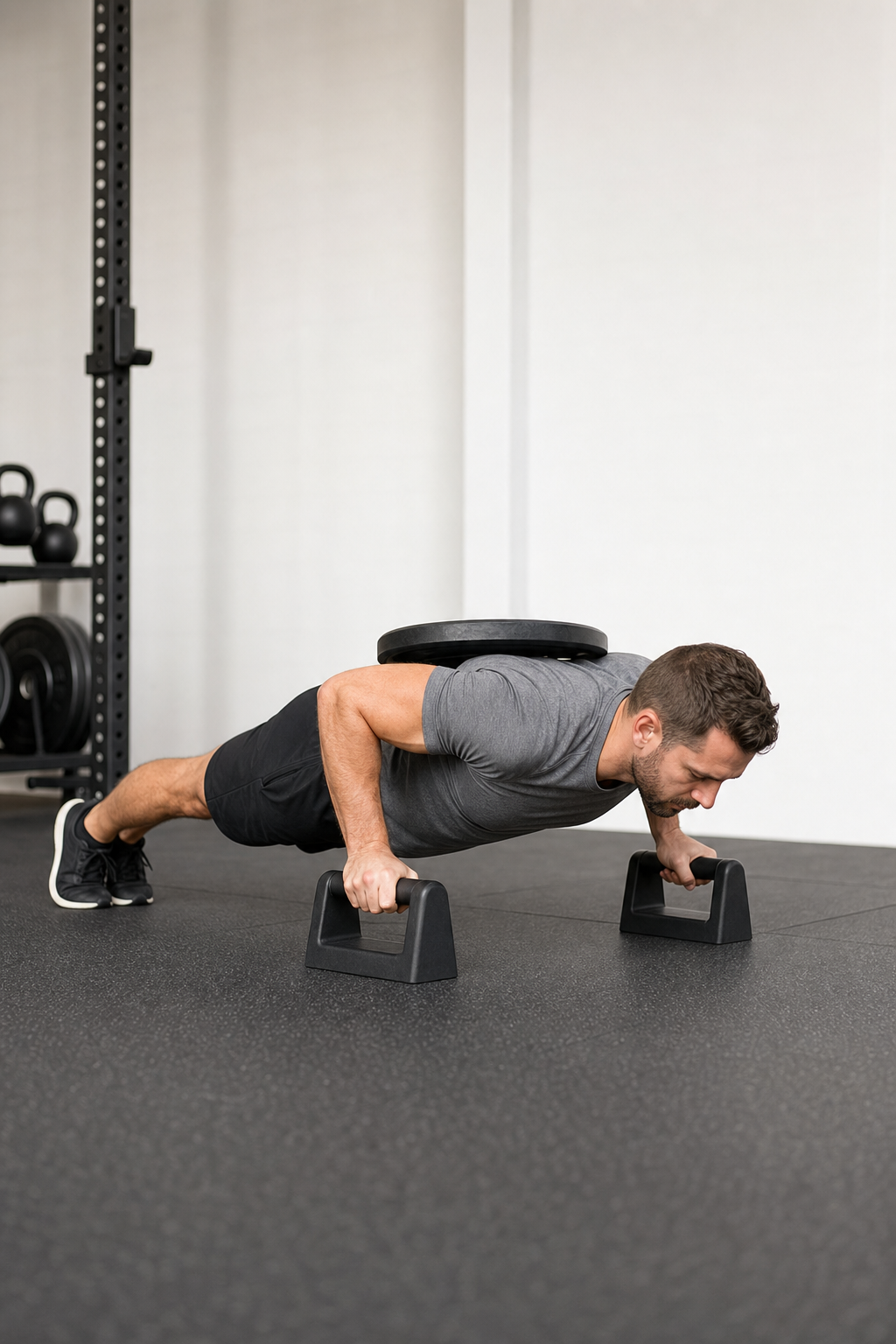
How to perform Weighted Deficit Push-Up
- Place hands on elevated objects (blocks or handles).
- Wear a weight vest or place a plate on your back.
- Keep body in straight line.
- Lower chest below hand level deeply.
- Push up to full extension.
- Repeat for desired reps.
What is Weighted Deficit Push-Up?
The weighted deficit push-up is an advanced push-up performed with the hands on sturdy raised supports so the chest can travel below hand level, while a vest or another secured resistance adds load. It combines a longer range of motion with more resistance than a standard push-up.
What muscles does Weighted Deficit Push-Up work?
The pectoralis major, triceps, and front deltoids perform the press through the deeper range. The serratus anterior, upper back, rotator cuff, abdominal wall, glutes, and legs stabilize the shoulders and keep the body rigid under load.
Weighted Deficit Push-Up form cues and common mistakes
- Use two equal-height, non-slip handles or blocks and test that they cannot tip or slide before adding resistance.
- Prefer a well-fitted weight vest or securely anchored band; do not balance a loose plate on your back without a capable spotter and a controlled setup.
- Brace the abdomen and glutes, keep the wrists stacked on the supports, and lower the whole body as one unit.
- Descend only as far as the shoulders remain comfortable and controlled; a deeper range is useful only when you can reverse it without collapsing forward.
- Reduce the load, support height, or range if the elbows flare sharply, the shoulders roll forward, or the hips sag before the chest rises.
How to add Weighted Deficit Push-Up to a workout
Treat weighted deficit push-ups as a primary pressing exercise after mastering unweighted deficit push-ups. Start with 3 to 5 sets of 4 to 10 repetitions, leaving 1 to 3 controlled reps in reserve. Add repetitions before increasing resistance, and avoid increasing depth and load in the same session.
Frequently asked questions
What is the benefit of a weighted deficit push-up?
The raised hand position can provide a longer range of motion, while the added resistance increases pressing demand. Together they make the chest, triceps, and shoulders work harder than during a standard push-up.
How should I add weight to deficit push-ups?
A fitted weight vest is usually the simplest option because it keeps the load close and secure. A resistance band can also work when anchored safely. Avoid an unsecured plate unless a capable spotter controls its placement and removal.
How many weighted deficit push-ups should I do?
Start with 3 to 5 sets of 4 to 10 controlled repetitions and leave 1 to 3 good reps in reserve. Reduce the load or depth if shoulder position, body alignment, or support stability changes.
Use controlled movement and an appropriate variation for your current ability. Stop if an exercise causes sharp pain, and seek qualified guidance when needed.